
She Insisted.
I've been a little behind in my postings, so many things going on. This incident happened about 2 months ago when there was still snow on the ground. It was a particularly nice day for us here in Minnesota, around 45° F. Snow was melting, birds were singing, sun was shining...a beautiful day. I was going in and out of our porch working on a project and it just so happens that Nani's play gym is close by. (I, of course, would shut the door behind me and was keeping a close eye on her) She kept beeping as she does when she wants something. Well like any good parent I told her she had to stay inside, that this weather was still not warm enough for little tropical birds from South America. And like most naughty little birds she didn't care one bit about what I had to say. So she sat there and calculated the exact moment I stepped out the door to jump over on my back. Little brat! She had her wings clipped so down into the snow she went. I happened to have my camera on because of the project I was working on and snapped a few photos before I brought her back inside. I guess even naughty little tropical birds get spring fever.


My Growl Baby
I've mentioned Nani's growling in past posts; she will growl when eating, surfing, or when she sees something that she doesn't recognise such as a bug crawling on the wall. The eating growl is a happy noise although it sounds exactly like her "aaahhh! hawk!" growl (video). I'm not totally sure if this is a Caique thing or one of Nani's quirks. I usually know why she's growling even though sometimes I don't see what she's looking at. For example, while outside she will be happily singing when all of a sudden she freezes, stares at the sky and softly growls. I know it's a hawk, but 9 times out of 10 I see absolutely nothing! Every now and then I can make out a tiny dot gliding around in the farthest layers of the ozone layer usually in the direct line of the sun. I don't know how she does it. I mentioned I usually know what she's growling at but there is one occasion that baffles me. We take a shower together several times a week, she sits on a towel rack that inside on the back wall. Now this happens every time: her eyes widen and tilting her head toward a specific spot on the ceiling just above the shower head, she starts to growl incessantly. Now one time, the first time, there was a tiny spider in that spot. But this has been going on for months and trust me, there is NOTHING there. And don't even bother trying to distract her, it's useless. She just gets this intent look on her face and doesn't stop till the shower ends. Once she goes up on her towel (on the shower curtain near the scary spot) she's totally oblivious. She does her towel surfing and the growling doesn't happen again till the next shower. I'm stumped. The only thing that could possibly be happening is that birds see in colors we don't and she may be seeing something in that spot happen when the steam hits it. But what? Or was she traumatized by that tiny baby spider never to be the same? I can't crack the case.
Does Nani Amuse Me Or Do I Amuse Nani?
Nani knows very well she is not supposed to crawl to the floor. But, of course, she takes any and every opportunity to do it. Examples of what she sees as opportunities: me leaving the room, me busy on the computer, me talking to someone on the phone, me watching a movie just when it's getting to the good part...me sitting, me staring directly at her, me saying "no! no! not on the floor!", etc.
So this morning I was watering my plants and I hear a plop onto the floor. Caiques are quite heavy for being such small birds and it is almost impossible for her to do anything quietly (thank goodness!). So there she is on the floor, but she's no fool! She would never run out in the open where she could easily be scooped up and put back on her stand! She must stay in the safety and cover of the forest. What forest? Why, the forest made up of various tables, chairs, and other large objects no one could possibly fit under other than a naughty Caique.
Although frustrating I can't say I don't get the giggles from time to time. She IS entertaining! Today was one of those days. But am I laughing at her, or she at me? You be the judge...
Nani Went To School
Yesterday I took Nani to my daughter's school to see all of the 2nd graders. Due to a few kids with allergies the teacher asked that we do it outside, which posed a few challenges. First off Nani loves going outside (and is accustomed to it) but is always "on the lookout". She spots hawks miles away and won't move a muscle all the while growling. She also does this to songbirds, squirrels, butterflies, gnats, and leaves blowing in the wind. Ok, so she's a scaredy cat. So she was not as relaxed as I would have liked but did amazingly well considering.
I talked to the kids about the two types of Caiques, where they come from, that they are a more rare species and they most likely would not see one at the local pet store. I also told them about what is required to care for not only Caiques but all parrots, and the sad truth about rescues filled to the brim with unwanted birds. The teacher chimed in and told them that it is important to think about what a big (and in some cases lifelong) responsibility it is to own a pet. Many of them had questions, some of them repetitive. It struck me as funny.
Although she refused to do her tricks (grrrrrr) she was very well behaved. I gave each of the 20+ students a sunflower seed and Nani gladly went around eating out of each hand. One girl put her hand up to feed her and Nani hopped right on. The teacher said that this particular girl was quite and animal lover and she believed animals can sense that. I agree. Oh, and Nani got spooked at one point by some annoying 5th graders that had come outside and flew on the back of one poor little boy. At least he didn't cry.
When my daughter got home she said everyone was asking if they could come over to the house. We have quite a zoo with 2 rats, a flying squirrel, two leopard geckos, and Nani which is of course very attractive to kids. So will my house be filled with children running around? Uh, yeah...not anytime soon.
☻
-
Have Caique? Caution!
I almost don't want to do today's post for fear I will look like an incompetent parrot owner, but I feel I must as maybe someone out there will learn from my mistakes.
Incident #1:
The day before yesterday I was cleaning house, and had gotten to the vacuuming portion. Nani was out on her stand, and has recently learned how to fly (quote, unquote) to the couch and will either climb down to the floor or go running to her cage. But she never leaves the tree when I'm vacuuming...until now. I was knelt down on the floor trying to vacuum under her cage, the disaster zone as I call it. I didn't see that she had come over to investigate and was standing on the arm of the couch right next to me. I went to vacuum part of the food mess she had left on that very part of the couch (using the attachment hose) and flooooop! She was sucked in!!!!!! Thankfully her body is pudgy and she got stuck there. I quickly turned it off, within a second, and my poor bird was making that noise they do when they hate something (like nail clipping), kind of a growl. So I went to pull her out and guess what...stuck! I was panicking, but pulled slightly harder and ploop, out she came! I brought her up to my face with my hand around her body and she immediately started making kissing noises. I kept telling her "I'm sorry, I'm sorry, I'm so sorry" while tears were rolling down my cheeks. She seemed flustered but otherwise fine, I couldn't believe it! After babying her for several minutes I set her on the couch to see what she'd do. Get this...she goes off bouncing up and down while saying "hop, hop, hop" in her squeaky voice. Then immediately attacked her toy and started whistling away. Needless to say I was flabbergasted, and left with severe heart palpitations of course.
Here is my sermon: When you are considering a Caique as a pet (which I highly recommend) and you read all the books and online info that say they are into everything, can't be trusted, and are highly active interpret that as: Caiques are rulers of your domain...nothing is off limits, when they look innocent always suspect the worst, and last but not least are little Tasmanian devils having endless energy and can run (or hop) from one end of the room to the other with triathlon speed!
Incident #2:
This one happened today. My daughter is notorious for leaving her things everywhere and I am constantly nagging her to pick up after herself. Yesterday she had a bunch of Hershey's kisses on the living room table (Nani's room). When we were about ready to leave the house I told her to pick them up and put them away, which she did. Fast forward to this morning at around 10 a.m. and Nani is out running around from her tree to her cage and back again, as normal. Now keep in mind the house is spotless as I just cleaned. So she decides to crawl down on the floor and eat the tidbits she's dropped. I was sitting right there with my laptop, so I let her be. She went exploring under the coffee table, which is also normal. All of a sudden I hear what sounds to me like when she chews apart the dry leaves outside. crunch crunch crunch. I say to her "what are you into?" and bend down to take a look. Ahhhhh! Chocolate! It was all over her beak! I freaked and rinsed it out the best I could. Then I immediately called the vet and explained. There was only a small chunk missing so I know she didn't eat much, and I had no idea if she had ingested the foil as it was all peeled and mashed into the chocolate kiss. My vet said that judging by the amount of chocolate that was missing it probably wouldn't be a problem. But she said if she ingested the foil she could become impacted and need surgery. I reexamined the leftovers and it seemed very unlikely that she had ingested much, if any. She told me to keep an eye on her and her droppings today. Now since this happened she has been absolutely normal, singing and eating like no tomorrow. I will continue to watch her closely...I love her so much!
Moral: Don't let your birds forage on the floor and always double check after your 8 year old claims to have cleaned!
Best Friends Forever
Einstein the African Grey parrot is somewhat of a celebrity on youtube.com. She is an excellent talker and very entertaining to watch! This 9 minute 35 second video is definitely worth the time. Here is Einstein's "Word Practice". Einstein also has a blog and website with fun facts, videos, and a friends page. Well, guess who her new friend is!

Nani spends a countless amount of time watching Einstein's videos intently and has learned to say "look at you!" with such expression.
So Nani would like to make a shout out to her new friend Einstein! Woo!
.
Nani is sick...
On Wednesday at around 3 pm I got in the shower with Nani. She loves the shower and sings away the whole time. Afterward I always put her on top of a towel hanging from the curtain rod. She always rubs vigorously all over the towel (see Caique surfing). Well she was up there on her towel as I was blow drying my hair when the towel, and Nani, came crashing down to the floor. Now to be honest I wasn't that surprised as this has happened a time or two before. So she waddled over to the counter and climbed the cord to the sink. When she got to the top I looked at her right as she shook her head, and I saw some blood on the wall. My heart just sank and I quickly turned off the blow dryer. There were drops of blood coming from the very tip of her beak, although none of it was broken off or chipped. I blotted with a kleenex and it stopped bleeding within a minute. She didn't lose much blood at all which is good because birds can bleed to death very quickly. She seemed startled so I brought her to her cage to rest.
I had two appointments that night so after coming back from the first one at around 5 pm I noticed she was acting kind of strange...making no sounds, not eating, and sleeping a lot. I was somewhat concerned but thought she may have just been shaken up from the bathroom incident.
I left for my second appointment around 7:30 pm and came back around 10:00. She didn't make a peep when we came in which is very out of the ordinary. I went right away to check on her and she was all puffed up and sleeping with her beak tucked in her back feathers. She never sleeps like that. I've heard most Caiques don't. She would also shake her head every few seconds as if to shake off the pain. Now my mild concern went straight to panic. She could hardly keep her eyes open! But it was late and I decided to give it time to see if she improved by morning, after a good nights sleep. I didn't fall asleep until about 3 am because I kept going to check on her.
Bright and early Thursday morning my husband came in to wake me and tell me she didn't look so good. I jumped out of bed to find her puffed, shaking a little, and struggling to keep her eyes open (like extreme fatigue). First I called the emergency vet's office but they said even though they could see her it would be better to take her to an avian specialist. I didn't think they were open that early but they did answer when I called. The girl told me the doctor was booked all day, but if I could drop her off as soon as possible the vet would see her between visits. What a sigh of relief! So I drove the 30 minutes to the vets office and dropped her off. Thankfully it got in the 40's today so it was relatively warm for taking her out. Now normally she loves car rides and sings and talks as loudly as she can. Today she was silent, although alert.
At around noon the avian vet called and told me that Nani has a hairline fracture from the very tip of her beak up to right below the middle (I cant see it at all). She said it wasn't a serious break but that it is extremely painful for her because all of the nerve endings are in that area. Being parrots use their beaks for almost everything - climbing, eating, playing, preening - she is a bit handicapped right now. She was given pain medication called Metacam which I have to give to her every 12 hours.
When I brought her home I tried mashing up some of her pellets mixed with freshly squeezed orange juice, but she only stuck her beak in a few times and gave up. I took her in the bedroom with me and she slept cuddled up to me for an hour until I had to go to my daughters conferences at school. Before I left I offered her a saltine cracker (not the healthiest of options, I know) and she took it! It was sad to watch though as she tried picking up more pieces of the cracker with the side of her face/beak which is almost impossible.
After coming back home I decided to give her some hulled sunflower seeds - which I normally reserve for trick training only - to see if she would take them. To my surprise she ate about 4 of them! yay! She also drank some water which was excellent. I was still dead tired from lack of sleep so at about 8:00 pm I took her in the bedroom to sleep with me (I am a VERY light sleeper, bat your eyelashes and I'll wake up). She didn't want to be pet at all but did snuggle in against my chest. She slept motionless for 4 hours! That is unheard of with Nani. The only reason she woke up at all was because I needed to go pee. I got a bit of video of her behavior right before we fell asleep. You can see her beak is obviously bothering her, and she can barely keep her eyes open.
I will keep updating her progress.
Rare bird, spooked by fireworks, thrashes itself to death
By DON JORDAN
Palm Beach Post Staff Writer
Thursday, January 01, 2009
LOXAHATCHEE GROVES — Fireworks used to ring in the New Year instead led to a horrific scene at a local wildlife conservation center, officials said.
Workers at the Rare Species Conservatory Foundation doing a routine morning check-up today discovered a dead red-browed Amazon parrot with severe head and face injuries.
It was obvious from the bird's injuries that it had thrashed itself to death against its enclosure, said Paul Reillo, director of the conservation center.
The parrot was part of a recovery project to breed the rare species and reintroduce it to its natural habitat in the lowland humid forests of Brazil. The wild population is estimated to be between 1,000 and 2,500 birds, according to Birdlife International, an international conservation organization.
Reillo said the birds and other animals always get spooked by the fireworks, but this is the first time an animal has reacted so violently.
"We're doing everything we can to save these species and the lack of enforcement on fireworks regulations is basically undoing our best efforts," he said. "In the middle of the night, they're not expecting blasts and fireworks and gunshots. It's getting worse every year."
All but two of the entire North American population of the bird in captivity live at the conservation center. The male parrot that died was healthy and "essential to the breeding program," Reillo said.
"It's genetics were well-documented," he said. "This guy could have lived to be 50 or 60 years old and could have produced a generation of wildlife. The tragedy is that this animal's life is sacrificed for absolutely no reason."
Law enforcement officials said they are aware of the fireworks problem in the western communities, where the loud blasts agitate horses and other animals, but have a hard time enforcing the regulations. Fireworks that leave the ground or explode are illegal, but loopholes exist, such as using the fireworks to frighten birds away from agricultural areas.
An officer must observe a person firing off illegal fireworks in order to take action, Palm Beach County Sheriff's Office spokeswoman Teri Barbera said.
Deputies often meet with local homeowners associations before the Fourth of July to discuss fireworks regulations and safety, she said.
"It's been an ongoing problem out there," said Barbera, adding that there were more fireworks going off near her Royal Palm Beach home on New Year's Eve than she had "ever seen in years past."
Wellington resident Kathy Bozich counted down to the New Year from her horse Kapoen's stable on Draft Horse Lane Wednesday night, fearing a repeat of the "major issues" she had this summer.
"The Fourth of July was like bombs going off," Bozich said. "He went berserk."
Reillo said the public needs to be aware of the potential consequences of shooting off illegal fireworks.
"Any excuse for a holiday, and it's like Baghdad out here," he said. "It comes at a terrible cost."
__________
More:
Save The Brooklyn Parrots
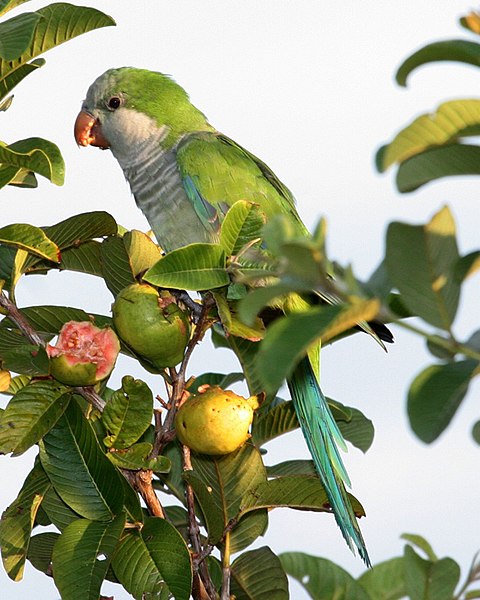
It’s a saga that brings tears to the eyes.
Years ago, back in the late 1960’s or 1970’s, some imported Argentinian parrots arrived in the US and set up housekeeping in Brooklyn, a section of New York famous for their immigrant neighborhoods.
How the Quaker Parrots got there is not known: theories range from being blown there by a hurricane to someone inadvertently opening a box at one of the nearby airports, and instead of finding contraband drugs or liquor, they found live parrots, who promptly flew the coop.
And, like other immigrants, they established families, who had more families…all over Brooklyn, despite Federal attempts to eradicate them. But it didn’t work.
BrooklynParrots website explains:
In 1973,… the Federal eradication teams, having achieved most of their parrot suppression efforts, approached one of the last remaining parrot strongholds, a nest complex on Rikers Island, Queens. After loading their guns and preparing their nets, a forward observation team reported disturbing news: the parrots had withdrawn and evidently disappeared into the fog….It will never be known whether the Rikers Island Parrots were “tipped off” by “someone on the inside” that the Feds were gunning for them. But it is likely that many of the birds we find today in Queens, the Bronx, and elsewhere are directly related to the survivors of the Great Rikers Island Monk Parrot Standoff.
The parrots, like other birds, sometimes are pesty and annoying, but the major problem is their nesting habits: the parrots build huge nests that allow the parrots to stay warm through the cold North American winter, but the tendency for the birds to use warm powerlines or electrical equipment instead of trees to build their nests has caused problems. Usually the nests have to be removed by workers, but at least six fires (plus neighborhood blackouts) have been caused by the birds.
So what should one do? Should the birds again be eradicated as a potentially dangerous foreign species, or should it be protected as any other local birds, many of which also originate elsewhere?
A local politician, Tony Avella, has proposed legislation that would protect the parrots and mandate that their nests be removed gently and relocated elsewhere outside of mating season so that the baby parrots won’t be harmed.
So, endangered species or dangerous pest?BrooklynParrots website has more information about the parrots, including videos for your enjoyment. Or you can watch the Ballad of the Brooklyn Parrots on YOUTUBE.
——————————–
Nancy Reyes is a retired physician living in the rural Philippines. Her website is FinestKind Clinic and Fishmarket.
Follow This Blog
Hello to all my new readers! Nani and I would like to thank you for stopping by. Please note that on the right side of the page, just below "Categories" is a link to "Follow This Blog". Once you click on the link you will be able to choose to follow publicly or privately. By choosing to follow The Doodle Bird Blog you can stay updated with this blog's posts on your Blogger Dashboard.
Hunt for George the Parrot, Stolen in House Raid
Link
A family is desperately searching for George, an African grey parrot, taken from their home by burglars.
Carina Archbold had been living in her new home in Swords,Co Dublin for less than a week with her two daughters when their home was broken into and parrot and their pet chihuahua was stolen.
The burglars left the family cat and another dog.
There have been several possible sightings of the missing African grey since the theft. However, none of the birds have turned out to be him.
Carina has heard no news about her long-haired Chihuahua Ruby since the theft nearly two weeks ago.
The family including Becky (18) and Ally (13) say they are "in bits" after the break-in. "We are really devastated," said Carina. The thieves took a PlayStation and an iPod as well, but the family is most upset about the missing animals.
"The parrot has my voice," said Carina. "He is a very clean parrot. He doesn't say dirty things." About the three-year-old chihuahua, she said: "She is the most amazing little dog." She was the baby of the house."
Both the parrot and the dog are pure breeds and are expensive pets. Carina had got Ruby micro-chipped and George has a ring on his leg. But despite these safety measures, the animals went missing.
"I can't believe somebody stole them from our house; we were only living there five days," said Carina. "George is seven-years of age and is grey with a red tail. We are very worried about him because he stresses a lot when he is not around us," she said.
"We have had him for seven years so he was very attached to us. He even speaks with my voice and says things like: 'Georgie loves his mammy'."
Ruby, the chihuahua who will be three this Christmas, is black and white, which is unusual for a pure breed of that dog.
Carina said she and her daughter went to a lot of effort to get this particular dog and they had to be vetted by the woman who bred her. "It was like adopting," said Carina. "Anyone would love Ruby the second they meet her; it's a horrific crime that someone would steal our family pets," she said.
Woman Braves Fire to Save Her Beloved Birds

Mashal Rizvi didn't have to think twice about rushing into a burning building to
save her pet birds.
To her, not rushing in would have been
unthinkable.
"If your kids were in the house, would you do the same thing?,"
she said. "The birds are my everything. They're my family."
Rizvi, 23, who
is studying to be a veterinarian at Howard Community College, works as a
veterinary technician at VCA North Rockville Animal Hospital in Rockville.
On Oct. 16 at about 4 p.m., she returned to her North Laurel house in the
11000 block of Birchtree Lane, where she lives with her parents and other family
members. She was the only one home at the time.
Rizvi turned on the TV and
caught up on "Grey's Anatomy," then started watching a movie version of "A Tale
of Two Cities."
A few minutes into the movie, she heard a loud pop coming
from the sunroom, next to the family room where she was watching
television.
"My parrots started screaming," she said.
Rizvi ran into the
sunroom and saw the air conditioning unit on fire. She grabbed the cordless
phone and called 911.
The fire started spreading quickly, so she picked up a
cage with two cockatiels in it and carried it outside to the deck behind the
sunroom.
Rizvi ran back into the sunroom and saw the fire had spread to the
carpet. She pulled two of her eclectus parrots from a large cage, which was too
cumbersome to haul outside, took the birds outside and set them on top of the
cockatiel cage.
She then remembered that she had one cockatiel left -- upstairs in her room.
"She's my baby," Rizvi recalled. "I ran back through the sunroom, through
the foyer and up the stairs. I had to act really fast, because that fire was
burning really, really fast."
Upstairs, she grabbed the bird and tucked it in
her pocket. Then she headed back downstairs.
When she got downstairs, Rizvi
faced a wall of smoke blocking her from going back out through the sunroom.
"There was a thick cloud of smoke," she said. "I had to duck and run out the
front door. There was no way I was going to be able to go out of the sunroom.
"
She made it to the front door and then tore around the back to the deck.
One parrot was still on the cage, but the other was missing. She called the
parrot's name and the parrot came running toward her.
"She screamed once. She
gave a little yell and started running towards me," she said.
Soon after, the
fire trucks arrived, she said.
"If I hadn't gone and got the birds they
would have died because that fire spread so fast," she said.
Anna Hoffmann, a spokeswoman for the Howard County Department of Fire and Rescue
Services, confirmed the unusual bird rescue at the Rizvi house.
But she said
it was not something the fire department recommends.
"While this had a
positive outcome, it doesn't always happen that way," Hoffmann said. Her
recommendation: "Notify a firefighter."
About 50 firefighters responded to
the fire at about 6 p.m. and had it out by 6:24 p.m., Hoffmann said. The fire
caused about $250,000 worth of damage, she added.
The house's kitchen,
family room and sunroom were destroyed by the fire, and there was extensive
smoke damage throughout the house, Rizvi said.
The family has moved out of
the house while it is being repaired.
Rizvi's father, Jaffer Rizvi, said he
knows that his daughter loves birds. Still, he has doubts about the wisdom of
her actions that day.
"I don't know if it's a smart thing to do," he
said.
His daughter has no such doubts.
"I wouldn't be able to live with
myself if I hadn't," she said.
Cognition And The Talking Bird
Alex the "talking parrot" died at the age of 31 back in 2007. He participated in many experiments with Dr. Irene Pepperberg that suggested he, and possibly other birds, could think and communicate at the level of a four or five year old child. Today I found a little snippet about Alex and Dr. Pepperberg I'd like to share. The story below is quoted from The Economist print edition:
Oct 23rd 2008

"The young Irene Pepperberg was not the only child to have been enthralled by the “Dr Dolittle” stories, in which a doctor is taught the language of animals by his parrot. But it is unlikely that anyone will match her tenacity in trying to make the stories come true. For the past 30 years, Dr Pepperberg, who studies parrots at Brandeis University in Massachusetts, has been producing research papers on the cognitive abilities of her African Grey, Alex, who died in September 2007 and who was the subject of an Economist obituary. In “Alex & Me” she has written a memoir of two unusual scientific careers, one of them pursued—not exactly by choice—by a bird.
As a lonely child in Brooklyn, Dr Pepperberg owned pet birds from the age of four, and daydreamed about being able to understand animals’ thoughts. A socially awkward chemistry student at the Massachusetts Institute of Technology (MIT) in Boston, she writes that talking to her parakeet was often her “only non-work-related exchange of the whole day”. It hardly comes as a surprise that she decided to switch from chemistry to the study of animal communication. When a pet-shop owner picked out an African Grey for her in 1977, she says she already expected that it would come to change the way people thought about the minds of animals.
Thus she knew from the start what she wanted to prove. That may seem suspiciously overconfident, but Dr Pepperberg certainly obtained some striking results. Alex (his name supposedly an acronym for Avian Learning Experiment) eventually learned the names of about 50 objects, knew the numerals from one to six, could perform simple addition and used categories such as similarity and difference, shape, colour and material. He apparently combined words to make up his own expressions (“yummy bread” for cake, for example). He also seemed to combine phonemes to construct new words. Lacking lips, he could not pronounce the letter “p”, so his term for an apple was “banerry” (apparently mixing “banana” and “cherry”). Most unnerving of all, he would make spontaneous remarks in appropriate circumstances, such as “What’s your problem?” and “I’m gonna go away now.”
The efforts required to bring forth such little marvels were immense. For the first 15 years of his life, Alex was talked to by his trainers for eight hours each day. Dr Pepperberg adapted the so-called “Model/Rival” method developed by a German ethologist in the 1970s; this uses two experimenters, one of whom, A, “teaches” the other, B, while sometimes switching attention to the parrot. In Dr Pepperberg’s version, A and B alternate their roles, to mimic the social context in which children learn to speak.
Finding the money for such labour-intensive research has been a constant struggle, and Dr Pepperberg relies on private donors and the generous help of volunteers. There is little sign, however, that other labs will be able to devote the enormous efforts required to replicate her work, as scientific method requires. Unfortunately for Alex’s legacy, this may mean that he comes to be remembered as little more than a unique curiosity."
More About Alex:
Dr. Pepperberg's new book titled Alex & Me: How a Scientist and a Parrot Discovered a Hidden World of Animal Intelligence--and Formed a Deep Bond in the Process
Product Description from Amazon.com:
On September 6, 2007, an African Grey parrot named Alex died prematurely at age
thirty-one. His last words to his owner, Irene Pepperberg, were "You be good. I
love you."
What would normally be a quiet, very private event was, in Alex's
case, headline news. Over the thirty years they had worked together, Alex and
Irene had become famous—two pioneers who opened an unprecedented window into the
hidden yet vast world of animal minds. Alex's brain was the size of a shelled
walnut, and when Irene and Alex first met, birds were not believed to possess
any potential for language, consciousness, or anything remotely comparable to
human intelligence. Yet, over the years, Alex proved many things. He could add.
He could sound out words. He understood concepts like bigger, smaller, more,
fewer, and none. He was capable of thought and intention. Together, Alex and
Irene uncovered a startling reality: We live in a world populated by thinking,
conscious creatures.
The fame that resulted was extraordinary. Yet there was
a side to their relationship that never made the papers. They were emotionally
connected to one another. They shared a deep bond far beyond science. Alex
missed Irene when she was away. He was jealous when she paid attention to other
parrots, or even people. He liked to show her who was boss. He loved to dance.
He sometimes became bored by the repetition of his tests, and played jokes on
her. Sometimes they sniped at each other. Yet nearly every day, they each said,
"I love you."
Alex and Irene stayed together through thick and thin—despite
sneers from experts, extraordinary financial sacrifices, and a nomadic existence
from one university to another. The story of their thirty-year adventure is
equally a landmark of scientific achievement and of an unforgettable
human-animal bond.
PBFD in Caiques: Tia's Story

"I got Tia from a breeder in December of 2006. This breeder had taken her in from a home where the owner died, but she attacked the husband and he did not want to keep her. Right from the time we got her, she was overly dependent on us - like she was lacking attention. She was moody and did not want to be removed from you. She played once in awhile, but not often.
I think I probably noticed something wasn't quite right from the beginning but I didn't look at it as sickness then, I thought it was a behavioural problem from being re-homed so much in such a short time."
That is how Delta, a parrot owner from Canada, describes how she and Tia first met. They had a close relationship from the start, but things quickly became clear as to why Tia was self mutilating.
"Later as things seemed to get worse, I noticed her reactions to things changing. When something would touch her, she would panic like it was going to kill her. She got moodier and cried if we touched her, like her skin was extremely sore. Most of her days and nights, when she was suppose to be sleeping, was instead spent pulling at herself and crying. She acted like she hated herself so much and wanted to hurt herself, but I now know that she must have been mentally exhausted from itching."
Tia's owner had no local resources, and suspecting this was more than just a case of feather plucking (which would have been bad enough), contacted a certified avian vet by email to ask his professional opinion. Here are a few of the photos she sent:


The avian vet quickly confirmed Delta's fears: this was a case of PBFD, or Psittacine Beak and Feather Disease. This illness is a deadly avian disease that, in it's early stages, may show no signs or symptoms. As it's name suggests, feather abnormalities and occasionally a deformed beak are some of the first signs that the bird may have this disease. Many infected birds will look and act perfectly normal for many years, although it is most common to manifest itself within the first 3 years of life. Unfortunately, PBFD is extremely contagious as viral particles are airborne, so no direct contact is necessary in order to infect another bird. The virus can attach itself to virtually anything; toys, feeding cups, seed/pellet mixes, used cages, nets, carriers, clothing, hair, ANYTHING. That means we should be very careful who and what we expose our pets to. In Tia's case, it is unknown where she may have been infected, but the effects were clear. Delta compassionately helped Tia to find some peace. On September 22, 2008 Tia was humanely put to sleep.*
"From what I know, she was 7 years old when she crossed over. Even though she was a challenge from the start, she was very dedicated to us. She may have attacked in the previous home but she accepted everyone in the household. She did not like strangers though and would bite. She didn't tend to want to be friends with the others either (feathered ones)... a very withdrawn bird.
She loved to surf like all Caiques do though. I have many shirts that she destroyed from chewing and surfing. She was special because she was Tia. She did not have the years she should have, and I was hoping to have spent many more with her. I have many birds whom I have dedicated to giving them the rest of their years with me - but I never intended for it to end so soon for Tia. I am so sorry she suffered the way she did and it is a terrible disease to see a feathered friend go through.
I miss her."
- As told by Tia's owner
*Not all birds with PBFD need to be euthanized, each case is individual. Many success stories have been reported of birds living with the disease. Recently, University of Georgia scientists have been working on finalizing development of a new vaccine that could effectively eliminate in companion bird populations the debilitating and often fatal disease. This vaccine would not be a cure, however, for already infected birds. Read more about the potential vaccine here.


 Posts
Posts


